In this context, the role of design is not merely to communicate information efficiently, but to create the conditions under which interpretation can occur. Participation becomes a way of designing for understanding, while graphics become a means of supporting both intellectual and emotional engagement. The museum is therefore not only a place where content is displayed, but a space in which visitors are invited to think, respond, and construct meaning for themselves. This repositions museum graphic design as a central agent in visitor experience, rather than a secondary layer of support.
In this context, the role of design is not merely to communicate information efficiently, but to create the conditions under which interpretation can occur. Participation becomes a way of designing for understanding, while graphics become a means of supporting both intellectual and emotional engagement. The museum is therefore not only a place where content is displayed, but a space in which visitors are invited to think, respond, and construct meaning for themselves. This repositions museum graphic design as a central agent in visitor experience, rather than a secondary layer of support.

Participation as Learning
Empathetic Design
Design as Engagement
Design as Engagement
Attention as a Designed Condition
Cognitive Design Theory
Visitor engagement in the museum context has increasingly come to be understood as an active, participatory process rather than a passive act of observation. Contemporary museum practice recognises that meaning is not simply transmitted from institution to audience, but is negotiated through the visitor’s actions, interpretations, and emotional responses. This shift is especially significant for museum graphic design, because graphic communication does not merely label or decorate the exhibition environment; it structures how visitors orient themselves, what they attend to, and how they make sense of what they encounter. As a result, participation becomes central to the design of the museum experience, linking learning, cognition, and empathy within a coherent visitor journey.
Visitor engagement in the museum context has increasingly come to be understood as an active, participatory process rather than a passive act of observation. Contemporary museum practice recognises that meaning is not simply transmitted from institution to audience, but is negotiated through the visitor’s actions, interpretations, and emotional responses. This shift is especially significant for museum graphic design, because graphic communication does not merely label or decorate the exhibition environment; it structures how visitors orient themselves, what they attend to, and how they make sense of what they encounter. As a result, participation becomes central to the design of the museum experience, linking learning, cognition, and empathy within a coherent visitor journey.
Attention in the museum is not a neutral or automatic response; it is a limited resource that must be supported by design. Bitgood’s attention-value model is useful here because it frames museum engagement as a negotiation in which visitors continuously assess whether an encounter is worth the cognitive effort it requires. Graphic design plays a decisive role in this negotiation by reducing friction, clarifying hierarchy, and making interpretive pathways more immediately legible. Through typography, pacing, sequencing, colour, and spatial organisation, design can make an exhibition feel approachable without making it simplistic.
In a post-digital context, this challenge becomes even more pronounced. Parry’s account of the post-digital museum describes how digital systems are embedded within the institution rather than remaining external to it, meaning that museum experience now unfolds across physical and digital layers simultaneously. Attention is therefore distributed across interfaces, environments, and devices, and graphic design must choreograph these transitions carefully. The result is that the museum visit is no longer experienced as a single linear encounter, but as a layered process of orientation, selection, response, and reflection.
Attention in the museum is not a neutral or automatic response; it is a limited resource that must be supported by design. Bitgood’s attention-value model is useful here because it frames museum engagement as a negotiation in which visitors continuously assess whether an encounter is worth the cognitive effort it requires. Graphic design plays a decisive role in this negotiation by reducing friction, clarifying hierarchy, and making interpretive pathways more immediately legible. Through typography, pacing, sequencing, colour, and spatial organisation, design can make an exhibition feel approachable without making it simplistic.
In a post-digital context, this challenge becomes even more pronounced. Parry’s account of the post-digital museum describes how digital systems are embedded within the institution rather than remaining external to it, meaning that museum experience now unfolds across physical and digital layers simultaneously. Attention is therefore distributed across interfaces, environments, and devices, and graphic design must choreograph these transitions carefully. The result is that the museum visit is no longer experienced as a single linear encounter, but as a layered process of orientation, selection, response, and reflection.
Cognitive design theory offers a useful framework for understanding why participatory museum experiences are effective. The theory suggests that design shapes mental processes such as attention, recognition, chunking, association, perception, and reasoning. In the museum environment, these processes are constantly at work as visitors interpret labels, navigate galleries, compare visual information, and connect new material to prior knowledge. Museum graphic design therefore has a direct cognitive function: it organises information in ways that support understanding, reduce confusion, and make complex content more approachable. Bitgood (2013) posits that visitor attention is a finite resource that needs to be earned rather than presumed. Effective cognitive design reduces the 'cost' of engagement through 'chunking' (breaking information into digestible units) thereby increasing the perceived 'value' of the exhibit. Recent predictive modeling confirms that layout and interface design determine up to 63% of visitor movement (Aouad et al., 2025).
Cognitive design theory offers a useful framework for understanding why participatory museum experiences are effective. The theory suggests that design shapes mental processes such as attention, recognition, chunking, association, perception, and reasoning. In the museum environment, these processes are constantly at work as visitors interpret labels, navigate galleries, compare visual information, and connect new material to prior knowledge. Museum graphic design therefore has a direct cognitive function: it organises information in ways that support understanding, reduce confusion, and make complex content more approachable. Bitgood (2013) posits that visitor attention is a finite resource that needs to be earned rather than presumed. Effective cognitive design reduces the 'cost' of engagement through 'chunking' (breaking information into digestible units) thereby increasing the perceived 'value' of the exhibit. Recent predictive modeling confirms that layout and interface design determine up to 63% of visitor movement (Aouad et al., 2025).
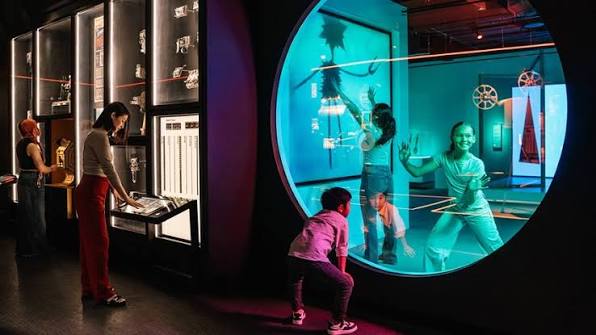
ACMI Melbourne offers a brilliant example of this cognitive dimension of visitor engagement. Its strong focus on visitor experience demonstrates how design can support exploration while still maintaining clarity and orientation. By using highly legible sans-serif typefaces scaled for varying viewing distances, high-contrast UI elements, and intuitive spatial pacing, ACMI reduces navigational friction. ACMI therefore illustrates how cognitive design and participation work together: the exhibition invites active engagement, but does so through a structure that supports attention and comprehension. The result is a visitor experience that feels both open and intelligible.
ACMI Melbourne offers a brilliant example of this cognitive dimension of visitor engagement. Its strong focus on visitor experience demonstrates how design can support exploration while still maintaining clarity and orientation. By using highly legible sans-serif typefaces scaled for varying viewing distances, high-contrast UI elements, and intuitive spatial pacing, ACMI reduces navigational friction. ACMI therefore illustrates how cognitive design and participation work together: the exhibition invites active engagement, but does so through a structure that supports attention and comprehension. The result is a visitor experience that feels both open and intelligible.
Empathetic design extends this discussion by asking what is meaningful to people and why. Empathetic design seeks to reduce that distance by creating experiences that are responsive, accessible, and attentive to the visitor’s perspective. It is not only concerned with usability, but also with emotional resonance and inclusion. Graphic design mediates this relationship through its visual tone, typography, and linguistic accessibility. Formal, over-dense, or visually opaque graphics reinforce institutional exclusion, alienating uninitiated audiences (Bourdieu & Darbel, 1991). Conversely, an empathetic design system uses clear typographic hierarchies, intuitive color-coding, and generous white space to build visitor confidence, transforming the exclusive identity of the "traditional museum-goer" into an inclusive platform for democratic agency.
Empathetic design extends this discussion by asking what is meaningful to people and why. Empathetic design seeks to reduce that distance by creating experiences that are responsive, accessible, and attentive to the visitor’s perspective. It is not only concerned with usability, but also with emotional resonance and inclusion. Graphic design mediates this relationship through its visual tone, typography, and linguistic accessibility. Formal, over-dense, or visually opaque graphics reinforce institutional exclusion, alienating uninitiated audiences (Bourdieu & Darbel, 1991). Conversely, an empathetic design system uses clear typographic hierarchies, intuitive color-coding, and generous white space to build visitor confidence, transforming the exclusive identity of the "traditional museum-goer" into an inclusive platform for democratic agency.
Museum graphic design is central to this process because it shapes the tone and legibility of the experience. Typography, language, pacing, hierarchy, and visual style all affect whether the visitor feels invited to participate or merely instructed to comply. A design system that is too dense, formal, or opaque may reinforce the impression that the museum is reserved for already initiated audiences. By contrast, a design system that is clear, generous, and considerate can signal openness and encourage confidence. Empathetic design therefore supports visitor engagement by making participation feel possible, legitimate, and worthwhile.
This is particularly relevant to the notion of the “museum goer,” which is itself a constructed identity shaped by institutional expectations. When museums design with empathy, they help broaden this identity, making room for more varied forms of participation and interpretation. In this sense, empathetic design is not simply about making the museum easier to use; it is about designing a relationship between institution and visitor that acknowledges difference and supports agency. It ensures that engagement is not reserved for the already confident, but available to a wider and more diverse public.
Museum graphic design is central to this process because it shapes the tone and legibility of the experience. Typography, language, pacing, hierarchy, and visual style all affect whether the visitor feels invited to participate or merely instructed to comply. A design system that is too dense, formal, or opaque may reinforce the impression that the museum is reserved for already initiated audiences. By contrast, a design system that is clear, generous, and considerate can signal openness and encourage confidence. Empathetic design therefore supports visitor engagement by making participation feel possible, legitimate, and worthwhile.
This is particularly relevant to the notion of the “museum goer,” which is itself a constructed identity shaped by institutional expectations. When museums design with empathy, they help broaden this identity, making room for more varied forms of participation and interpretation. In this sense, empathetic design is not simply about making the museum easier to use; it is about designing a relationship between institution and visitor that acknowledges difference and supports agency. It ensures that engagement is not reserved for the already confident, but available to a wider and more diverse public.
Taken together, participation as learning, cognitive design theory, and empathetic design provide a strong framework for understanding visitor engagement in museum graphic design. Participation explains why museums increasingly invite active involvement; cognitive design explains how visitors are supported in making sense of that involvement; and empathetic design explains how the experience can be made inclusive and meaningful. Museum graphic design sits at the intersection of these three concerns because it mediates between the institution’s intentions and the visitor’s experience. It shapes how the museum is read, how it is navigated, and how it is felt. The museum experience is not limited to the gallery floor; as Falk and Dierking (2012) argue in their Contextual Model of Learning, it begins with the visitor's 'identity-related motivations' and extends into post-visit reflection. Graphic design acts as the connective tissue across these personal, social, and physical contexts.
Taken together, participation as learning, cognitive design theory, and empathetic design provide a strong framework for understanding visitor engagement in museum graphic design. Participation explains why museums increasingly invite active involvement; cognitive design explains how visitors are supported in making sense of that involvement; and empathetic design explains how the experience can be made inclusive and meaningful. Museum graphic design sits at the intersection of these three concerns because it mediates between the institution’s intentions and the visitor’s experience. It shapes how the museum is read, how it is navigated, and how it is felt. The museum experience is not limited to the gallery floor; as Falk and Dierking (2012) argue in their Contextual Model of Learning, it begins with the visitor's 'identity-related motivations' and extends into post-visit reflection. Graphic design acts as the connective tissue across these personal, social, and physical contexts.
Participation becomes a way of designing for understanding, while graphics become a means of supporting both intellectual and emotional engagement.
Participation becomes a way of designing for understanding, while graphics become a means of supporting both intellectual and emotional engagement.
This is particularly important in museums where visitors are expected to engage with a high volume of information, multiple media, or unfamiliar subject matter. If the design is poorly structured, the visitor may struggle to determine where to look, how to proceed, or what the exhibition is asking of them. If the design is clear and well paced, however, it can support the visitor in building meaning gradually and confidently. In this sense, cognitive design acts as an architecture of understanding. It transforms visual communication into a framework that supports interpretation, allowing the visitor to process information without becoming overwhelmed.
This is particularly important in museums where visitors are expected to engage with a high volume of information, multiple media, or unfamiliar subject matter. If the design is poorly structured, the visitor may struggle to determine where to look, how to proceed, or what the exhibition is asking of them. If the design is clear and well paced, however, it can support the visitor in building meaning gradually and confidently. In this sense, cognitive design acts as an architecture of understanding. It transforms visual communication into a framework that supports interpretation, allowing the visitor to process information without becoming overwhelmed.